|
An antelope grazing in Africa hears a sound in the grass.
Immediately all the neuronal clusters concerned with danger are preactivated so
the lion is recognized as soon as it emerges from the grass, and the antelope is
able to escape. Such presensitization is a key part of how the brain works and
why it is so efficient.
It is not possible to be presensitized in
different directions at the same time just as it would not be possible to design
a golf club that was the best club for driving and at the same time the best
club for putting. That is why the Six Hats method is essential. It allows the
brain to maximize its sensitivity in
different directions at different times. It
is simply not possible to have that maximum sensitization in different
directions all at the same time.
Argument versus Parallel
Thinking
The basic idea behind Western thinking
was designed about twenty-three hundred years ago by the Greek "Gang of Three"
and is based on argument.
Socrates put a high emphasis on dialectic and argument. In 80 percent of the
dialogues in which he was involved (as written up by Plato) there is no
constructive outcome at all. Socrates saw his role as simply pointing out what
was "wrong." He wanted to clarify the correct use of concepts like justice and
love by pointing out incorrect usage. Plato believed that the "ultimate"
truth was hidden below appearances. His famous analogy is of a person chained up
in a cave so that he can see only the back wall of the cave. There is a fire at
the entrance to the cave. After a person enters the cave, his shadow is
projected onto the back wall of the cave and that is all the chained-up person
can see. Plato used this analogy to point out that as we go through life we can
see only the "shadows" of the truth.
Aristotle systematized inclusion/exclusion logic. From past experience we would
put together "boxes," definitions, categories or principles. When we came across
something, we judged into which box it fell. Something could be in the box or
not in the box. It could not be half in and half out — nor could it be anywhere
else.
As a result, Western thinking is
concerned with "what is," which is determined by analysis, judgement and
argument.
That is a fine and useful system. But
there is another whole aspect of thinking that is concerned with "what can be," which involves
constructive thinking, creative thinking, and "designing a way
forward."
Many cultures in the world, perhaps even
the majority of cultures, regard argument as aggressive, personal and
nonconstructive. That is why so many cultures readily take up the parallel
thinking of the Six Hats method.
A Changing World
A thinking system based on argument is
excellent just as the front left wheel of a car is excellent. There is nothing
wrong with it at all. But it is not sufficient.
A doctor is treating a child with a rash.
The doctor immediately thinks of some possible "boxes." Is it sunburn? Is it
food allergy? Is it measles? The doctor then examines the signs and symptoms and
makes a judgement. If the doctor judges that the condition fits into the
"measles" box, then the treatment of measles is written on the side of that
"box" and the doctor knows exactly what to do. That is traditional thinking at
its best.
From the past we create standard
situations. We judge into which "standard situation box" a new situation falls.
Once we have made this judgement, our course of action is clear.
Such a system works very well in a stable world.
In a stable world the standard situations of the past still apply. But in a
changing world the standard situations may no longer apply.
Instead of judging our way forward, we
need to design our way forward. We need to be thinking about "what can be," not
just about "what is."
Yet the basic tradition of Western
thinking (or any other thinking) has not provided a simple model of constructive
thinking. That is precisely what the Six Hats method (parallel thinking) is all
about.
What Is Parallel
Thinking?
There is a large and beautiful country
house. One person is standing in front of the house. One person is standing
behind the house. Two other people are standing on each side of the house. All
four have a different view of the house. All four are arguing (by intercom) that
the view each is seeing is the correct view of the house.
Using parallel thinking they all walk
around and look at the front. Then they all walk around to the side, then the
back, and finally the remaining side. So at each moment each person is looking
in parallel from the same point of view.
This is almost the exact opposite of
argument, adversarial, confrontational thinking where each party deliberately
takes an opposite view. Because each person eventually looks at all sides of the
building, the subject is explored fully. Parallel thinking means that at any
moment everyone is looking in the same direction.
But parallel thinking goes even further.
In traditional thinking, if two people disagree, there is an argument in which
each tries to prove the other party wrong. In parallel thinking, both views, no
matter how contradictory, are put down in parallel. If, later on, it is
essential to choose between the differing positions, then an attempt to choose
is made at that point. If a choice cannot be made, then the design has to cover
both possibilities.
At all times the emphasis is on designing
a way forward.
Directions and Hats
The essence of parallel thinking is that
at any moment everyone is looking in the same direction — but the direction can
be changed. An explorer might be asked to look north or to look east. Those are
standard direction labels. So we need some direction labels for thinking. What
are the different directions in which thinkers can be invited to
look?
This is where the hats come
in.
In many cultures there is already a
strong association between thinking and "thinking hats" or "thinking caps." The
value of a hat as a symbol is that it indicates a role. People are said to be
wearing a certain hat. Another advantage is that a hat can be put on or taken
off with ease. A hat is also visible to everyone around. For those reasons I
chose hats as the symbols for the directions of thinking.
Although physical hats are sometimes
used, the hats are usually imaginary. Posters of the hats on the walls of
meeting rooms often are used, however, as a reminder of the directions. There
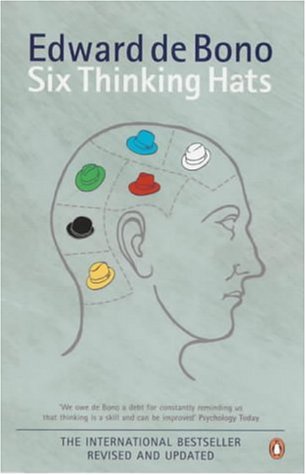
are six colored hats corresponding to the six directions of thinking:
white, red, black, yellow, green,
blue.
Directions Not
Descriptions
It is very important to note that the
hats are directions and not descriptions of what has happened. It is not a
matter of everyone saying what they like and then the hats being used to
describe what has been said. It is a matter of setting out to think in that
direction.
"Let's have some white hat thinking here"
means a deliberate focus on information. Everyone now tries to think of
information that is available, information that is needed, questions to be
asked, other ways of getting information, and so on.
"I want your red hat on this" is a
specific request for feelings, intuition and emotions on a particular
issue.
"That is good black hat thinking; now let
us switch to some yellow hat thinking. . . ." In this case the term
black hat
describes thinking that seems to be cautious and seems to point out possible
difficulties, but the main intention is to ask for a switch to the yellow hat
direction (benefits, values, and so forth).
It is extremely important to appreciate
the difference between description and direction. A description is concerned
with what has happened. A direction is concerned with what is about to
happen.
"I want you to cook some scrambled eggs"
is very different from "I see that you have cooked some scrambled
eggs."
Not Categories of
People
It is possible to create tests to
determine whether a person is type A or type B, or any similar descriptive
discriminations. Psychologists do that all the time. The difficulty is that once
people have been put into "boxes" they tend to stay there. Again, that is an
example of "what is" instead of "what can be."
In a race a thin man would usually
beat a fat man ("what is"). But if the fat man learns to ride a bicycle, then
the fat man will beat the thin man ("what can be").
There is a huge temptation to use the
hats to describe and categorize people, such as "she is black hat" or "he is a
green hat person." That temptation must be resisted. The hats are not
descriptions of people but modes of behavior.
It is true that some people may be
permanently cautious and inclined to look for dangers. It is true that some
people might always be bubbling with ideas and others might be better at
focusing on facts. People may prefer one mode to another. People might be better
at one mode than another. Nevertheless, the hats are not categories of
people.
If you drive a car with a manual
gearshift, you use all the gears. In the engine of your car all cylinders are
firing. The hats are directions of thinking. Every person must be able, and
skilled, to look in all the directions.
For those reasons the use of the hats as
labels is dangerous because it destroys the whole point of the system, which is
that everyone can look in every direction.
Note on Using the Thinking
Hats
When people tell me that they have been
using the Six Hats method, I often ask how they have been using it, and discover
that sometimes they have been using it incorrectly. In a meeting, someone has
been chosen as the black hat thinker, someone else as the white hat thinker, and
so on. The people then keep those roles for the whole meeting. That is almost
exactly the opposite of how the system should be used. The whole point of parallel thinking is that the experience and
intelligence of everyone should be used in each direction. So everyone present wears the black hat at the appointed
time. Everyone present wears the white hat at another time. That is parallel
thinking and makes fullest use of everyone's intelligence and
experience.
Showing Off
Many people tell me that they enjoy
argument because they can show off how clever they are. They can win arguments
and demolish opponents. None of that is very constructive but there may be a
human need to show off.
Thus showing off is not excluded from
parallel thinking and the Six Hats method. A thinker now shows off by showing
how many considerations he or she can put forward under the yellow hat, how many
under the black hat, and so forth. You show off by performing well as a thinker.
You show off by performing better as a thinker than others in the meeting. The
difference is that this type of showing off is constructive. The ego is no
longer tied to being right.
Playing the Game
There are all sorts of attempts to change
the personalities of people. It is believed that if you point out a personality
type or a weakness, the person will seek to compensate for that weakness. Such
methods are generally slow, ineffective and do not work.
Once people are put into a certain "box"
or category they may try to compensate. But the effort of compensation reminds
them of "what they are," so they sink even deeper into that category.
Ever since Freud, the emphasis has been
on analysis: find out the deep truths and motivations for action. Confucius's
approach was almost the exact opposite. Instead of focusing on personality he
chose to focus directly on behavior. He urged you to use the right behavior with
your colleagues, your subordinates, your superiors and your family. Confucius
was not the least bit interested in your personality or psychological
makeup.
The Six Hats method follows the
Confucian approach rather than the analytical one. The rules of behavior are laid out. You follow those rules. If you are
aggressive, no one is going to try to make you less aggressive. But if the
yellow hat is in use, then you are to use your aggression in that
direction.
By going straight to behavior, the Six
Hats method is much more acceptable and effective and quick than methods that
set out to change personalities.
The "game" aspect of the Six Hats is very
important. If a game is being played, then anyone who does not obey the rules of
the game is considered uncooperative. If there is a switch from the black hat
(caution) to the yellow hat (possible benefits) and a person continues to lay
out the potential dangers, then that person is seen to be refusing to play the
game. Getting people to "play the game" is a very powerful form of changing
behavior.
Results
Over the years the results of using the
Six Hats method have become increasingly clear. The results are based on
feedback from many sources and fall into four broad categories that are
summarized here.
Power
With the Six Hats method, the
intelligence, experience and knowledge of all the members of the group are fully
used. Everyone is looking and working in the same direction.
A magnet is powerful because all the
particles are aligned in the same direction. That is not the case with argument
or free discussion. With the argument mode (as in a court of law), each party
seeks to win the case. If one party thinks of a point that might benefit the
other party, then that point is never raised. The purpose is to win, not to
explore the subject honestly.
It is totally absurd that a person should
hold back information or a point of view because revealing it would weaken his
or her argument. The focusing of the sun's rays can melt the toughest of metals.
In the same way, the focusing of the mental ability of many people on a problem
can more easily solve that problem.
Time Saving
In the United States, managers spend
nearly 40 percent of their time in meetings. If the Six Hats method reduced all
meeting times by 75 percent, you would have created 30 percent more manager time
— at no extra cost whatsoever.
In normal thinking or argument, if
someone says something, then others have to respond — even if only out of
politeness. But that is not the case with parallel thinking.
With parallel thinking, every thinker at
every moment is looking in the same direction. The thoughts are laid out in
parallel. You do not respond to what the last person has said. You simply add
another idea in parallel. In the end, the subject is fully explored
quickly.
Normally, if two points of view are at
odds, then they are argued out. With parallel thinking, both points of view are
laid out alongside each other. Later on, if it is essential to decide between
the two, a decision is made. So there is not argument at every step.
Removal of Ego
Perhaps the biggest obstacle to quick and
effective thinking is the ego. People tend to use thinking to parade their egos.
Thinking is used to attack and put down other people. Thinking is used to get
your own way. Thinking is used to show others how clever you are. Thinking is
used to express personal antagonisms.
Someone will choose to disagree on a
point simply to show up the person who has made that point. If another person
had made the point, there would have been full agreement. In general, we do not
fully realize just how obstructive the ego is in preventing effective
thinking.
During jury deliberations, there are
often two personalities who refuse to agree whatever the evidence might be.
Judges have told me that that is a much more serious problem than most people
realize. Clearly, the problem destroys the basic value of the jury system. That
is why there is now interest in several countries in training all juries in the
Six Hats method. This would speed up deliberations by removing the ego
problem.
Confrontational and adversarial thinking
exacerbate the ego problem. Six Hats thinking removes it. With the Six Hats
method you exert your ego by performing well as a thinker under each of the
hats.
The Six Hats method provides neutral and
objective exploration of a subject — argument does not.
One Thing at a
Time
Confusion is the biggest enemy of good
thinking. We try to do too many things at the same time. We look for
information. We are affected by feelings. We seek new ideas and options. We have
to be cautious. We want to find benefits. Those are a lot of things that need
doing.
Juggling with six balls at the same time
is rather difficult. Tossing up one ball at a time is much easier.
With the Six Hats method, we try to do
only one thing at a time. There is a time when we look for danger (black hat).
There is a time when we seek new ideas (green hat). There is a time when we
focus on information (white hat). We do not try to do everything at the same
time.
With color printing, each color is
printed separately, one at a time, and in the end the full color effect is
obtained. It is the same with Six Hat thinking — we do one thing at a time and
in the end the full picture emerges.
Underneath all this is the absolute
physiological need to separate out the types of thinking. As I mentioned in the
introduction, the brain is sensitized to look for danger and sensitized to seek
benefits through a different chemical setting.
Airplanes coming in to land often fly
over car parks. If you tell yourself to notice the yellow cars, then suddenly
the yellow cars pop up and make themselves visible. That is an example of
sensitization.
You cannot be sensitized in different
directions at the same time, so when we set out to do all aspects of thinking at
the same moment, we are going to be suboptimal on all of them.
"Six thinking hats":
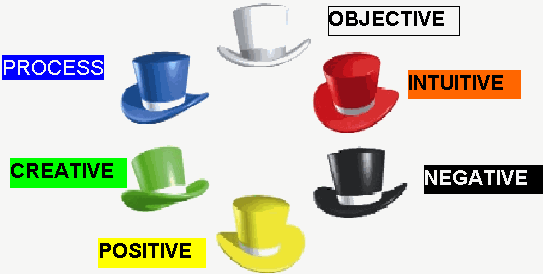
- White Hat: neutral and objective, concerned with
facts and figures
- Red Hat: the emotional view
- Black Hat: gloomy and negative, the "devil's
advocate" hat
- Yellow Hat: sunny and positive, seeing the good
side even of bad situations
- Green Hat: associated with fertile growth,
creativity, and new ideas
- Blue Hat: cool, the color of the sky, above
everything else - the organizing hat
In a discussion, all participants use the
same "hat" at the same time, speaking all up under the hat. So even a person in
favour of a new idea has to think about negative points and a person against a
new idea will also have to think about positive points.
Example:
The directors of a property company are looking at whether they should
construct a new office building. The economy is doing well, and the amount of
vacant office space is reducing sharply. As part of their decision they decide
to use the 6 Thinking Hats technique during a planning meeting.
Looking at the problem with the White Hat, they analyze the data they have.
They examine the trend in vacant office space, which shows a sharp reduction.
They anticipate that by the time the office block would be completed, that there
will be a severe shortage of office space. Current government projections show
steady economic growth for at least the construction period.
|
|
With Red Hat thinking, some of the directors think the
proposed building looks quite ugly. While it would be highly cost-effective,
they worry that people would not like to work in it.
When they think with the Black Hat, they worry that government
projections may be wrong. The economy may be about to enter a 'cyclical
downturn', in which case the office building may be empty for a long time.
If the building is not attractive, then companies will choose
to work in another better-looking building at the same rent.
With the Yellow Hat, however, if the economy holds up and
their projections are correct, the company stands to make a great deal of
money.
If they are lucky, maybe they could sell the building before
the next downturn, or rent to tenants on long-term leases that will last through
any recession. |
With Green Hat thinking they consider whether they should change the design
to make the building more pleasant. Perhaps they could build prestige offices
that people would want to rent in any economic climate. Alternatively, maybe
they should invest the money in the short term to buy up property at a low cost
when a recession comes.
The Blue Hat has been used by the meeting's Chair to move between the
different thinking styles. He or she may have needed to keep other members of
the team from switching styles, or from criticizing other peoples' points.
|