|
Conflict
management
Possible reasons for conflicts:
Personal: Lack of conflict experiences, mistrust, jealousy,
bad mood, etc.
Situational: Lack of communication, feeling of unfair
treatment, loss of face, etc.
Structural: Dependence, power struggle, struggle for
resources, etc.
Societal: Group antagonisms, class struggle
Conflicts are necessary and unavoidable.
They can create new ideas and better solutions but only if managed
in a proper and constructive way.
Forms of conflicts:
Distribution conflict
Role conflict
Value conflict
Methods conflict
Goal conflict
etc.
Open agenda vs. hidden agenda of conflicts:
"This time I get the cake, you had it last time"
vs. "Who
did not wash the dishes?"
Open and hidden signs
of conflicts: Spoken language and body language, action
|
Each student individually:
Please think about a
recent conflict you have been involved in
and describe
it:
-
Reason: Personal/Situational/Structural/Societal
- Form: Distribution/Role/Value/Methods/Goal/Other:
- Result:
You have 5 minutes to prepare and 2 minutes
to present afterwards.
|
Example Mediation: http://www.eucon-institut.de/index.html
"Mediation is a modern, cooperative method of conflict resolution in
which a neutral third person, called the mediator, supports the parties in
settling their dispute.
The mediation procedure is a flexible and confidential out-of-court method in
which the adversarial parties jointly work out an agreement in professionally
managed and structured negotiations.
The essential difference from court
litigation lies in the fact that the parties themselves actively and on their
own cooperate in finding a solution to their dispute that accords with their
interests. The power to decide on continuing the mediation procedure and its
outcome remains with the parties at all times. The mediator in this context is
neither a judge nor an arbitrator but a broker brought in by both sides to guide
them, on the basis of his/her training and experience, through the procedure
without coercion. With professional competence and appropriate methods the
mediator provides the parties with support in defining their interests and
jointly developing problem solutions oriented towards the future.
As a flexible and adaptive procedure, a rigid procedural route is
alien to mediation. Its classic structure makes it possible to distinguish five
phases.
| |
|
|
Phase 1

|
begins when the mediator opens negotiations by
explaining the salient points of the procedure. Mediation rules are discussed
and documented. |
|
|
|
Phase 2
|
Here the parties present their perspectives on the conflict
from a summary of which the mediator develops joint agreement on the
items to be taken up. |
|
|
|
Phase 3
|
Next rigid positions are left behind and the concrete interests
behind them are uncovered. Bringing the parties' motives into the open
intensifies mutual understanding. |
|
|
|
Phase 4
|
comprises development of a solution. The parties jointly
work out and evaluate different possible solutions. The objective is to find a
win-win solution that all parties can benefit from. |
|
|
|
Phase 5
|
After agreement about a mutually acceptable solution mediation is concluded
in Phase 5 by the precise definition of that agreement and,
where relevant, its legal formulation. |
|
What are the differences
between
- mediation
- moderation and
- finding a compromise?
|
Confrontation patterns:
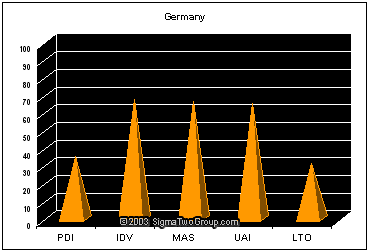
Germany:
Voicing of existence of conflict,
exchange
of arguments,
attempt to find compromise,
attempt to find rule for
future conflict situation
(Cool - Hot - Cool)
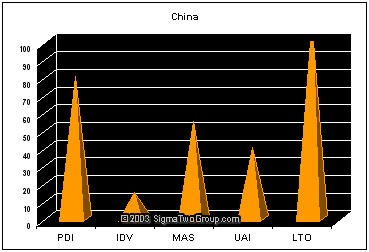
East Asia:
Denying of existence of conflict,
stressing
of common ground,
use of third parties,
after establishment of winner:
lenience by winner or
without establishment of winner: abrupt stop of communication
(Friendly - more friendly
- friendly or break up)
Example "Shall we
dance?" Japan 1996 and Remake R. Gere, J. Lopez 2004
The accountant Shohei Sugiyama (Kôji Yakusho) is feeling bored with his routine
life, limited to hard work and stay at home with his wife Masako Sugiyama
(Hideko Hara) and his teenager's daughter. One night, while traveling home by
train, he sees the beautiful face of Mai Kishikawa (Tamiyo Kusakari) in the
balcony of a dance school, and a couple of days later, he decides to visit the
school and secretly take ballroom dance lessons every Wednesdays night. However,
he becomes ashamed to tell his family his secret. Meanwhile, Masako feels the
changes in the behavior of her happier husband, and hires a private eye to
investigate whether Shohei is having an affair.
John Clark is a man with a wonderful job, a charming wife and a loving family,
who nevertheless feels that something is missing as he makes his way every day
through the city. Each evening on his commute home, John sees a beautiful woman,
staring with a lost expression through the window of a dance studio. Haunted by
her gaze, John impulsively jumps off the train one night, and signs up for dance
lessons, hoping to meet her. At first, it seems like a mistake. His teacher
turns out to be not Paulina, but the older Miss Mitzi, and John proves just as
clumsy as his equally clueless classmates on the dance-floor. Even worse, when
he does meet Paulina, she icily tells John she hopes he has come to the studio
to seriously study dance and not to look for a date. But, as his lessons
continue, John falls in love with dancing. Keeping his new obsession from his
family and co-workers, John feverishly trains for Chicago's biggest dance
competition. His friendship with Paulina blossoms, as his enthusiasm rekindles
her own lost passion for dance. But the more time John spends away from home,
the more his wife becomes suspicious. With his secret about to be revealed, John
will have to do some fancy footwork to keep his dream going and realize what it
is he really yearns for.
http://www.youtube.com/watch?v=bibtqDxXv1o
|