|
DEMAND MEETS
SUPPLY:
Destinations
Two definitions:
"A destination area is a place having characteristics which
are known to a sufficient number of potential visitors to justify
its consideration as an entity, attracting travel independently
of the attractions of other locations." (Wall/Mathieson 2006)
"Destinations are locations of tourism consumption"
(Hall 2005)
Destinations are varying according to perceived distance
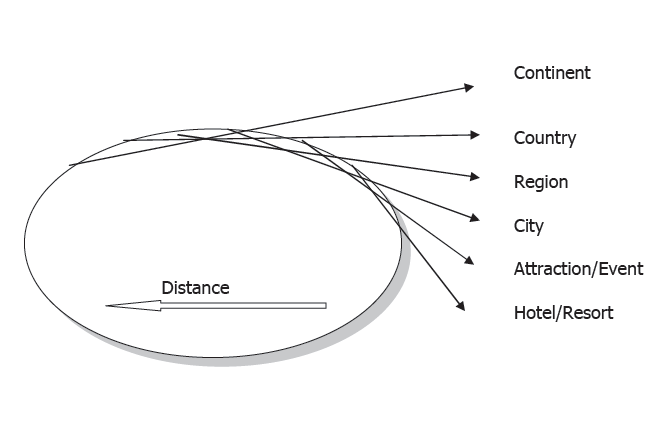
Influences on perceived distance of touristical destinations:
- topographical elements
- political borders
- language borders
- climate differences
- time differences
- cultural and social contrast
- accessibility (time/money)
|
Example: Please list by distance (road km) the
following cities:
Amsterdam, Copenhagen, Köln, Madgeburg, Passau,
Prag, Sczeczin, Stuttgart, Vienna, Warsaw
|
Amsterdam 466, Copenhagen 331, Köln
433, Madgeburg 233, Passau 818, Prag 645, Sczeczin 349, Stuttgart
667, Vienna 1096, Warsaw 878
The size of a destination is perceived as
smaller with growing distance
|
Example: Please list by size (sq km) the following
countries:
Germany, Pakistan, Papua New Guinea, Paraguay,
Peru, Poland, Philippines
|
| Pakistan |
796.095 qkm |
| Papua-New Guinea |
462.840 qkm |
| Paraguay |
406.752 qkm |
| Peru |
1.285.216 qkm |
| Philippines |
298.170 qkm |
| Poland |
312.684 qkm |
| Portugal |
92.289 qkm |
|
|
Destinations and their offers are often categorized into
"original" and "derived" (Claude
Kaspar). This assumes that their first is an "original"
attractive offer (beach, culture) and that the "derived"
offers (infrastructure) follows.
In fact NO place is interesting by itself,
what is considered as interesting changes over time.
Examples: Alps, Ocean.
Places can change from being attractive in
one season to another
(Mountains - summer --> winter, Nice winter
--> summer)
or be attractive for different target groups
in different times
(Florida winter destination for Americans, summer
destination for Europeans)
ALL destinations are social constructions, some even including
the name:
"Als romantisches "Land der Burgen, Höhlen
und Mühlen" ist die Fränkische Schweiz in den letzten 200 Jahren immer und
zurecht gesehen worden. "Entdeckt" wurde die Gegend 1774 mit der
Veröffentlichung eines spekakulären Höhlenbuches vom Uttenreuther Pfarrer
Friedrich. Esper. In den folgenden Jahren kamen zuerst zahlreiche Forscher
und entdeckten sensationelle Funde in unseren unzähligen Höhlen. Später dann,
als der Name des "Muggendorfer Gebürg" - so hieß die Gegend noch bis
1812, in Fachkreisen ein Begriff war, durchstreiften prominete Künstler wie
J. W. von Goethe, Ludwig Richter und Ernst Moritz Arndt die Gegend. Ihre
Berichte, vor allem die Reisebeschreibung Tiecks und Wackenroders mehrten den
guten Ruf unseres Landstriches, lockten weitere zahllose Gäste aus nah und fern
an und begründeten damit den Tourismus in der Fränkischen Schweiz. Mittlerweile
zählt die Region jährlich rund 1,5 Millionen Übernachtungen und rund eine
Million Tagesgäste. Trotzdem ist die "Fränkische" nicht überlaufen, im
Gegenteil: bedingt durch die verwinkelten geografischen Verhältnisse
"zerstreuen" sich unsere Gäste auf viele hundert typisch fränkische
Ortschaften." (www.fraenkische-schweiz.com)
|