|
Scientific Thinking and Writing - A refresher
Scientific sources
and How to use a Library
There are different scientific sources in a hierarchy:
First level:
Scientific books (monographies, edited volumes)
articles in scientific magazines (Annals of Tourism Research,
Tourism Management...)
proceedings of scientific conferences
PhD theses
statistical data from official sources
own primary research (questionaire, participating research, experts
interviews etc.)
Second level:
Textbooks (Oldenbourg Vlg.)
"Scripts" of lectures (not for citation!)
articles in trade magazines (fvw)
statistical data from company PR
Third level:
Newspaper articles
dictionaries
online sources
wikis
personal experiences
hearsay, "common knowledge"
If easily available and relevant, sources should be cited first-hand,
not from another source:
NOT important statistical data easily available from primary
source:
The number of visitors to Büsum in 2007 increased by 6%
(Dithmarscher Landeszeitung 2008)
OK Literary quote from old book (Heinrich Heine: Die Nordsee):
"Die Eingeborenen sind meistens blutarm und leben vom Fischfang.
(...) Die Tugend der Insulanerinnen wird durch ihre Hässlichkeit und
gar besonders durch ihren Fischgeruch, der mir wenigstens unerträglich
war, vorderhand geschützt." (Heine 1826, in: Schmidt 2008, 46)
How to find sources?
- Library catalogue (Normally free of charge but not very
up-to-date)
- Booksellers / Publishers (more up-to-date than
libraries)
- Bibliographies (in primary sources or
compilations, often online)
Articles in scientific magazines:
Index on website of magazine. Not indexed in library catalogue!
Some websites:
Library catalogue (Normally free of charge but not very
up-to-date)
http://www.fh-westkueste.de/
http://www.gbv.de/
http://www.ub.fu-berlin.de/
Booksellers / Publishers (more up-to-date than
libraries)
www.amazon.de www.amazon.com
http://www.buchhandel.de
http://www.bh.com/ (Elsevier)
http://www.routledge.com
http://www3.interscience.wiley.com/cgi-bin/home
http://www.channelviewpublications.com/
http://www.barnesandnoble.com/
www.zvab.com
Bibliographies:
http://www.tourismusausbildung.at
http://www.fremdenverkehrsgeographie.de/
http://www.wttc.org/
http://www.world-tourism.org/
http://www.geog.nau.edu/tg/contents/support/index.html
http://www.waksberg.com/
http://coombs.anu.edu.au/Biblio/biblio_tourism1.html
http://www.asienhaus-bibliothek.de
Scientific Writing
Step
1: Read a book about
Scientific Writing.
Information resources in our FHW library: Search
for "Wissenschaftliches
Arbeiten" shows 77 results!
How to find a topic:
Seven steps:
 Decide on broad field of topic, first review of literature Decide on broad field of topic, first review of literature
"Brainstorming": First focusing
Naming working title
Further research followed by naming of main questions and main
hypotheses
Decision on methods to use
Draft Content
First draft of text
Elements of
a scientific paper:
IntroductionYou can't
write a good introduction until you know what the body of the paper says.
Consider writing the introductory section(s) after you have completed the rest
of the paper, rather than before.
Be sure to include a hook at the beginning of the
introduction. This is a statement of something sufficiently interesting to
motivate your reader to read the rest of the paper, it is an
important/interesting scientific problem that your paper either solves or
addresses. You should draw the reader in and make them want to read the rest of
the paper.
The next paragraphs in the introduction should cite
previous research in this area. It should cite those who had the idea or ideas
first, and should also cite those who have done the most recent and relevant
work. You should then go on to explain why more work was necessary (your work,
of course.)
What else belongs in the introductory
section(s) of your paper?
- A statement of the goal of the paper: why the study
was undertaken, or why the paper was written. Do not repeat the abstract.
- Sufficient background information to allow the
reader to understand the context and significance of the question you are trying
to address.
- Proper acknowledgement of the previous work on
which you are building. Sufficient references such that a reader could, by going
to the library, achieve a sophisticated understanding of the context and
significance of the question.
- Explain the scope of your work, what will and will
not be included.
- A verbal "road map" or verbal "table of contents"
guiding the reader to what lies ahead.
- Is it obvious where introductory material ("old
stuff") ends and your contribution ("new stuff") begins?
MethodsWhat belongs in the "methods" section of a scientific paper?
- Information to allow the reader to assess the
believability of your results.
- Information needed by another researcher to
replicate your experiment.
- Description of your materials, procedure, theory.
- Calculations, technique, procedure, equipment, and
calibration plots.
- Limitations, assumptions, and range of validity.
The methods section should answering
the following questions and caveats:
- Could one accurately replicate the study (for
example, all of the optional and adjustable parameters on any sensors or
instruments that were used to acquire the data)?
- Could another researcher accurately find and
reoccupy the sampling stations or track lines?
- Is there enough information provided about any
instruments used so that a functionally equivalent instrument could be used to
repeat the experiment?
- If the data is in the public domain, could another
researcher lay his or her hands on the identical data set?
- Could one replicate any laboratory analyses that
were used?
- Could one replicate any statistical analyses?
- Could another researcher approximately replicate
the key algorithms of any computer software?
Citations in this section should be limited to data sources and
references of where to find more complete descriptions of procedures.
Do not
include descriptions of results. Results
- The results are actual statements of observations,
including statistics, tables and graphs.
- Indicate information on range of variation.
- Mention negative results as well as positive. Do
not interpret results - save that for the discussion.
- Lay out the case as for a jury. Present sufficient
details so that others can draw their own inferences and construct their own
explanations.
- Break up your results into logical segments by
using subheads
Note: Results vs. Discussion
SectionsQuarantine your observations from
your interpretations. The writer must make it crystal clear to the reader which
statements are observation and which are interpretation. In most circumstances,
this is best accomplished by physically separating statements about new
observations from statements about the meaning or significance of those
observations. Alternatively, this goal can be accomplished by careful use of
phrases such as "I infer ..." vast bodies of geological literature became
obsolete with the advent of plate tectonics; the papers that survived are those
in which observations were presented in stand-alone fashion, unmuddied by
whatever ideas the author might have had about the processes that caused the
observed phenomena.
How do you do this?
- Physical separation into different sections or
paragraphs.
- Don't overlay interpretation on top of data in
figures.
- Careful use of phrases such as "We infer that ".
- Don't worry if "results" seem short.
Why?
- Easier for your reader to absorb, frequent shifts
of mental mode not required.
- Ensures that your work will endure in spite of
shifting paradigms.
DiscussionStart with a few sentences that summarize the most important
results. The discussion section should be a brief essay in itself, answering the
following questions and caveats:
- What are the major patterns in the observations?
(Refer to spatial and temporal variations.)
- What are the relationships, trends and
generalizations among the results?
- What are the exceptions to these patterns or
generalizations?
- What are the likely causes (mechanisms) underlying
these patterns resulting predictions?
- Is there agreement or disagreement with previous
work?
- Interpret results in terms of background laid out
in the introduction - what is the relationship of the present results to the
original question?
- What is the implication of the present results for
other unanswered questions in earth sciences?
- Multiple hypotheses: There are usually several
possible explanations for results. Be careful to consider all of these rather
than simply pushing your favorite one. If you can eliminate all but one, that is
great, but often that is not possible with the data in hand. In that case you
should give even treatment to the remaining possibilities, and try to indicate
ways in which future work may lead to their discrimination.
- Avoid bandwagons: A special case of the above.
Avoid jumping a currently fashionable point of view unless your results really
do strongly support them.
- What are the things we now know or understand that
we didn't know or understand before the present work?
- Include the evidence or line of reasoning
supporting each interpretation.
- What is the significance of the present results:
why should we care?
This section
should be rich in references to similar work and background needed to interpret
results. However, interpretation/discussion section(s) are often too long and
verbose. Is there material that does not contribute to one of the elements
listed above? If so, this may be material that you will want to consider
deleting or moving. Break up the section into logical segments by using
subheads. Conclusions
- What is the strongest and most important statement
that you can make from your observations?
- If you met the reader at a meeting six months from
now, what do you want them to remember about your paper?
- Refer back to problem posed, and describe the
conclusions that you reached from carrying out this investigation, summarize new
observations, new interpretations, and new insights that have resulted from the
present work.
- Include the broader implications of your results.
- Do not repeat word for word the abstract,
introduction or discussion.
Recommendations
- Remedial action to solve the problem.
- Further research to fill in gaps in our
understanding.
- Directions for future investigations on this or
related topics.
Acknowledgments Advisor(s) and anyone who helped you:
- technically (including materials, supplies)
- intellectually (assistance, advice)
- financially (for example, departmental support,
travel grants)
References
- cite all ideas, concepts, text, data that are not
your own
- if you make a statement, back it up with your own
data or a reference
- all references cited in the text must be listed
- There are different styles of referencing. Choose one and follow it.
Appendices
- Include all your data in the appendix.
- Reference data/materials not easily available
(theses are used as a resource by the department and other students).
- Tables (where more than 1-2 pages).
- Calculations (where more than 1-2 pages).
- You may include a key article as appendix.
- If you consulted a large number of references but
did not cite all of them, you might want to include a list of additional
resource material, etc.
- List of equipment used for an experiment or details
of complicated procedures.
- Note: Figures and tables, including captions,
should be embedded in the text and not in an appendix, unless they are more than
1-2 pages and are not critical to your argument.
Crosscutting
Issues
What Are We Looking
For?We are looking for a critical analysis.
We want you to answer a scientific question or hypothesis. We would like you to
gather evidence -- from various sources -- to allow you to make interpretations
and judgments. Your approach/methods should be carefully designed to come to
closure. Your results should be clearly defined and discussed in the context of
your topic. Relevant literature should be cited. You should place your analysis
in a broader context, and highlight the implications (regional, global, etc.) of
your work. We are looking for a well-reasoned line of argument, from your
initial question, compilation of relevant evidence, setting data in a
general/universal context, and finally making a judgment based on your analysis.
Your thesis should be clearly written and in the format described below.
Writing for an
AudienceWho is your audience?
- Researchers working in analogous field areas
elsewhere in the world (i.e. other strike-slip faults, other deep sea fans).
- Researchers working in your field area, but with
different techniques.
- Researchers working on the same interval of
geologic time elsewhere in the world.
- All other researchers using the same technique you
have used .
- If your study encompasses an active process,
researchers working on the same process in the ancient record.
- Conversely, if your study is based on the rock
record, people studying modem analogs.
- People writing a synthesis paper on important new
developments in your field.
- People applying earth science to societal problems
(i.e. earthquake hazard reduction, climate warming) who will try to understand
your paper.
- Potential reviewers of your ms. or your thesis
committee.
Skimming vs.
ReadingBecause of the literature explosion,
papers are more skimmed than read. Skimming involves reading the abstract, and
looking at the figures and figure captions. Therefore, you should construct your
paper so that it can be understood by skimming, i.e., the conclusions, as
written in your abstract, can be understood by study of the figures and
captions. The text fills out the details for the more interested reader.
Order of WritingYour thesis is not written in the same order as it is
presented in. The following gives you one idea how to proceed.
- first organize your paper as a logical argument
before you begin writing
- make your figures to illustrate your argument
(think skimming)
- the main sections are: background to the argument
(intro); describing the information to be used in the argument, and making
points about them (observations), connecting the points regarding the info
(analysis), summing up (conclusions).
- outline the main elements: sections, and
subsections
- begin writing, choosing options in the following
hierarchy - paragraphs, sentences, and words.
Here is another approach.
- Write up a preliminary version of the background
section first. This will serve as the basis for the introduction in your final
paper.
- As you collect data, write up the methods section.
It is much easier to do this right after you have collected the data. Be sure to
include a description of the research equipment and relevant calibration plots.
- When you have some data, start making plots and
tables of the data. These will help you to visualize the data and to see gaps in
your data collection. If time permits, you should go back and fill in the gaps.
You are finished when you have a set of plots that show a definite trend (or
lack of a trend). Be sure to make adequate statistical tests of your results.
- Once you have a complete set of plots and
statistical tests, arrange the plots and tables in a logical order. Write figure
captions for the plots and tables. As much as possible, the captions should
stand alone in explaining the plots and tables. Many scientists read only the
abstract, figures, figure captions, tables, table captions, and conclusions of a
paper. Be sure that your figures, tables and captions are well labeled and well
documented.
- Once your plots and tables are complete, write the
results section. Writing this section requires extreme discipline. You must
describe your results, but you must NOT interpret them. (If good ideas occur to
you at this time, save them at the bottom of the page for the discussion
section.) Be factual and orderly in this section, but try not to be too dry.
- Once you have written the results section, you can
move on to the discussion section. This is usually fun to write, because now you
can talk about your ideas about the data. If you can come up with a good
cartoon/schematic showing your ideas, do so. Many papers are cited in the
literature because they have a good cartoon that subsequent authors would like
to use or modify.
- In writing the discussion session, be sure to
adequately discuss the work of other authors who collected data on the same or
related scientific questions. Be sure to discuss how their work is relevant to
your work. If there were flaws in their methodology, this is the place to
discuss it.
- After you have discussed the data, you can write
the conclusions section. In this section, you take the ideas that were mentioned
in the discussion section and try to come to some closure. If some hypothesis
can be ruled out as a result of your work, say so. If more work is needed for a
definitive answer, say that.
- The final section in the paper is a recommendation
section. This is really the end of the conclusion section in a scientific paper.
Make recommendations for further research or policy actions in this section. If
you can make predictions about what will be found if X is true, then do so. You
will get credit from later researchers for this.
- After you have finished the recommendation section,
look back at your original introduction. Your introduction should set the stage
for the conclusions of the paper by laying out the ideas that you will test in
the paper. Now that you know where the paper is leading, you will probably need
to rewrite the introduction.
- You must write your abstract last.
Figures and Tables
- The actual figures and tables should be
embedded/inserted in the text, generally on the page following the page where
the figure/table is first cited in the text.
- All figures and tables should be numbered and cited
consecutively in the text as figure 1, figure 2, table 1, table 2, etc.
- Include a caption for each figure and table, citing
how it was constructed (reference citations, data sources, etc.) and
highlighting the key findings (think skimming). Include an index figure (map)
showing and naming all locations discussed in paper.
- You are encouraged to make your own figures,
including cartoons, schematics or sketches that illustrate the processes that
you discuss. Examine your figures with these questions in mind:
- Is the figure self-explanatory?
- Are your axes labeled and are the units indicated?
- Show the uncertainty in your data with error bars.
- If the data are fit by a curve, indicate the
goodness of fit.
- Could chart junk be eliminated?
- Could non-data ink be eliminated?
- Could redundant data ink be eliminated?
- Could data density be increased by eliminating
non-data bearing space?
- Is this a sparse data set that could better be
expressed as a table?
- Does the figure distort the data in any way?
- Are the data presented in context?
- Does the figure caption guide the reader's eye to
the "take-home lesson" of the figure?
- Figures should be oriented vertically, in portrait
mode, wherever possible. If you must orient them horizontally, in landscape
mode, orient them so that you can read them from the right, not from the left,
where the binding will be.
Tying the Text to the
Data "Show them, don't just tell them…"
Ideally, every result claimed in the text should be documented with data,
usually data presented in tables or figures. If there are no data provided to
support a given statement of result or observation, consider adding more data,
or deleting the unsupported "observation."
Examine figure(s) or table(s)
pertaining to the result(s).
Assess whether:
- the data support the textual statement
- the data contradict the textual statement
- the data are insufficient to prove or refute the
textual statement
- the data may support the textual statement, but are
not presented in such a way that you can be sure you are seeing the same
phenomenon in the data that the author claims to have seen.
Giving CreditHow does one fairly and accurately indicate who has made what
contributions towards the results and interpretations presented in your paper?:
by referencing, authorship, and acknowledgements.
Different types of errors:
- direct quotes or illustrations without quotation
marks, without attribution
- direct quotes without quotation marks, with
attribution
- concepts/ideas without attribution
- concepts/ideas with sloppy attribution
- omitting or fabricating data or results
Check references carefully and reread
reference works prior to publication. The first time you read something, you
will consciously remember some things, but may subconsciously take in other
aspects. It is important to cross check your conscious memory against your
citations.
III. Editing Your
ThesisEven a rough draft should be edited.
Copy Editing
- Proof read your thesis a few times.
- Check your spelling. spellcheckers are useful for
initial checking, but don't catch homonyms (e.g. hear, here), so you need to do
the final check by eye.
- Make sure that you use complete sentences
- Check your grammar: punctuation, sentence
structure, subject-verb agreement (plural or singular), tense consistency, etc.
- Give it to others to read and comment.
Content Editing
- logic
- repetition, relevance
- style
Avoiding
ambiguity
- Do not allow run-on sentences to sneak into your
writing; try semicolons.
- Avoid nested clauses/phrases.
- Avoid clauses or phrases with more than two ideas
in them.
- Do not use double negatives.
- Do not use dangling participles (i.e. phrases with
an "-ing" verb, in sentences where the agent performing the action of the "-ing"
verb is not specified: " After standing in boiling water for two hours, examine
the flask.").
- Make sure that the antecedent for every pronoun
(it, these, those, that, this, one) is crystal clear. If in doubt, use the noun
rather than the pronoun, even if the resulting sentence seems a little bit
redundant.
- Ensure that subject and verb agree in number
(singular versus plural).
- Be especially careful with compound subjects. Be
especially careful with subject/verb agreement within clauses.
- Avoid qualitative adjectives when describing
concepts that are quantifiable ("The water is deep." "Plate convergence is
fast." "Our algorithm is better.") Instead, quantify. ("Water depths exceed
5 km.")
- Avoid noun strings ("acoustic noise source location
technique").
- Do not use unexplained acronyms. Spell out all
acronyms the first time that you use them.
Thesis lengthWrite for brevity rather than length. The goal is the
shortest possible paper that contains all information necessary to describe the
work and support the interpretation.
Avoid unnecessary repetition and
irrelevant tangents.
Necessary repetition: the main theme should be
developed in the introduction as a motivation or working hypothesis. It is then
developed in the main body of the paper, and mentioned again in the discussion
section (and, of course, in the abstract and conclusions).
Some suggestions
on how to shorten your paper:
- Use tables for repetitive information.
- Include only sufficient background material to
permit the reader to understand your story, not every paper ever written on the
subject.
- Use figure captions effectively.
- Don't describe the contents of the figures and/or
tables in the text item-by-item. Instead, use the text to point out the most
significant patterns, items or trends in the figures and tables.
- Delete "observations" or "results" that are
mentioned in the text for which you have not shown data.
- Delete "conclusions" that are not directly
supported by your observations or results.
- Delete "interpretation" or "discussion" sections
that are inconclusive.
- Delete "interpretation" or "discussion" sections
that are only peripherally related to your new results or observations.
- Scrutinize adjectives, adverbs and prepositional
phrases.
Although it varies
considerably from project to project, average thesis length is about 40 pages of
text plus figures. This total page count includes all your text as well as the
list of references, but it does not include any appendices. These
generalizations should not be taken too seriously, especially if you are working
on a labor-intensive lab project. If you have any questions about whether your
project is of sufficient scope, consult one of us early
on.
Writing for an
International Audience
- Put as much information as possible into figures
and tables. In particular, try to find a way to put your conclusions into a
figure, perhaps a flowchart or a cartoon.
- Don't assume that readers are familiar with the
geography or the stratigraphy of your field area.
- Every single place-name mentioned in the text
should be shown on a map.
- Consider including a location map, either as a
separate figure or as an inset to another figure. If your paper involves
stratigraphy, consider including a summary stratigraphic column--in effect, a
location map in time.
- Use shorter sentences. Avoid nested clauses or
phrases.
- Avoid idioms. Favor usages that can be looked up in
an ordinary dictionary. "Take the beaker out of the oven immediately..." rather
than "Take the beaker out of the oven right away..."
Thesis or paper consists of Main body (text)
and "apparatus" (Content, Lists, Bibliography etc.)
Main body of text:
|
Method of working |
Results |
Presentation |
|
complete |
relevant |
understandable |
|
systematic, methodical |
new |
convincing |
|
logical correct |
true |
easy to understand |
|
verifyable |
verifyable |
formally correct |
|
critical |
useful |
appropriate |
|
independent |
|
|
Example:
Chapter Organization Guidelines by a
publisher of a scientific magazine:
For consistency of publication, please adhere to the following guidelines
when preparing your chapter. Length of Chapter
8000-12000 words:
√ Introduction
Describe the general perspective of
this chapter. Toward the end, specifically state the objectives of the
chapter.
√ Background
Provide broad definitions and
discussions of the topic and incorporate views of others (literature review)
into the discussion to support, refute or demonstrate your position on the
topic.
√ Main Thrust of the Chapter
1. Issues, Controversies, Problems
Present
your perspective on the issues, controversies, problems, etc., as they relate to
theme and arguments supporting your position. Compare and contrast with what has
been, or is currently being done as it relates to your specific topic and the
main theme of the book.
2. Solutions and Recommendations
Discuss
solutions and recommendations in dealing with the issues, controversies, or
problems presented in the preceding section.
√ Future Trends
Discuss future and emerging trends. Provide insight about the future of
the book’s theme from the perspective of your topic. Viability of a paradigm,
model, implementation issues of proposed programs, etc., may be included in this
section. If appropriate, suggest future research opportunities within the domain
of the topic.
√ Conclusion
Provide discussion of the overall
coverage of the chapter and concluding remarks.
√ References
APA (American Psychological Association)
style must be followed for the references.
References should relate only to material cited within the manuscript and be
listed in alphabetical order, including author's name, complete title of the
cited work, title of the source, volume, issue, year of publication, and pages
cited. Please do not include any abbreviations. Please see the following
examples:
One
author:
Author,
A. A. (1994). Title of work. Location/City, State:
Publisher.
Two
authors:
Author,
A. A., & Author, B. B. (1994). Title of work.
Location/City, State:
Publisher.
More than two
authors:
Author,
A. A., Author, B. B., & Author, C. C. (1994). Title of work.
Location/City, State:
Publisher.
Journal
article:
Sawyer,
S., & Tapia, A. (2005). The sociotechnical nature of mobile computing work:
Evidence from a study of policing in the United States. International
Journal of Technology and Human Interaction, 1(3), 1-14.
Instance of
publication in press:
Junho,
S. (in press). Roadmap for e-commerce standardization in Korea. International
Journal of IT Standards and Standardization Research.
Edited
book:
Zhao, F.
(Ed.). (2006). Maximize business profits through e-partnerships. Hershey, PA: IRM Press.
Chapter in an
edited book:
Jaques,
P. A., & Viccari, R. M. (2006). Considering students’ emotions in
computer-mediated learning environments. In Z. Ma (Ed.), Web-based
intelligent e-learning systems: Technologies and applications (pp. 122-138). Hershey, PA: Information Science
Publishing.
Report from a
university:
Broadhurst, R. G., & Maller, R. A. (1991). Sex offending and
recidivism (Tech. Rep. No. 3). Nedlands,
Western Australia: University of Western Australia, Crime Research
Centre.
Published
proceedings:
Deci, E.
L., & Ryan, R. M. (1991). A motivational approach to self: Integration in
personality. In R. Dienstbier (Ed.), Nebraska Symposium
on Motivation: Vol. 38. Perspectives on motivation (pp. 237-288). Lincoln: University of Nebraska
Press.
Unpublished
doctoral dissertation or master’s thesis:
Wilfley,
D. (1989). Interpersonal analyses of bulimia: Normal-weight and obese.
Unpublished doctoral dissertation,
University of Missouri, Columbia.
Paper presented at
… :
Lanktree, C., & Briere, J. (1991, January). Early data on the
Trauma Symptom Checklist for Children (TSC-C). Paper presented at the meeting of the American Professional Society on
the Abuse of Children, San Diego, CA.
Web
site:
VandenBos, G., Knapp, S., & Doe, J. (2001). Role of reference elements in the selection of resources by psychology
undergraduates. Journal of Bibliographic Research, 5, 117-123. Retrieved October 13, 2001, from http://jbr.org/articles.html
When
using the source in the text, state the author's name and year of publication.
Please see the following examples:
Example 1: In most organizations, data resources are
considered to be a major resource (Brown, 2002; Smith, 2001).
Example 2: Brown (2003) states that the value of data is
recognized by most organizations.
When
quoting another author’s work, the author's name, the date of publication, and
the page(s) on which the quotation appears in the original text should
follow the direct quote.
Example 1: Brown (2002) states that "the value of data
is realized by most organizations" (p. 45).
Example 2: "In most organizations,
data resources are considered to be a major organization asset" (Smith, 2003,
pp. 35-36) and must be carefully monitored by the senior
management.
For further information concerning the APA style, consult your library or contact: Order Department, American
Psychological Association, P.O. Box 92984, Washington, DC 20090-2984 or
www.apastyle.org, for a copy of the Publication Manual of the American
Psychological Association – 5th edition for APA style.
You may also find it helpful to consult the
following Web sites:
http://www.apastyle.org/faqs.html
http://www.apastyle.org/previoustips.html
√ Details to keep in
mind:
- Make sure that complete editing of the chapter is conducted to ensure
proper English language usage, grammatical structure, spelling and punctuation.
Attention to these details will contribute to clear, concise communication of
your ideas.
- LaTex files cannot be accepted
because they are not compatible with IGI’s typesetting
program.
· Only original chapters
will be accepted for publication in IGI books. Upon acceptance
of your chapter, you will be required to sign a warranty that the chapter is original and has not been
submitted for publication or published
elsewhere.
NOTE: It is your responsibility
to obtain written permission to include any copyrighted materials in your
chapter. The publisher of the book requires a copy of the written permission
submitted with the final version of the chapter. In addition, all trademark use
within the manuscript must be credited to its owner or written
permission to use the name must be granted.
Citing sources
The most important citation rules: APA,
MLA, Harvard and Chicago:
Citation
APA Style
Citation MLA Style
Citation Harvard Style
Citation Chicago Style
Comparing different styles: http://library.duke.edu/research/citing/workscited/index.html
Examples:
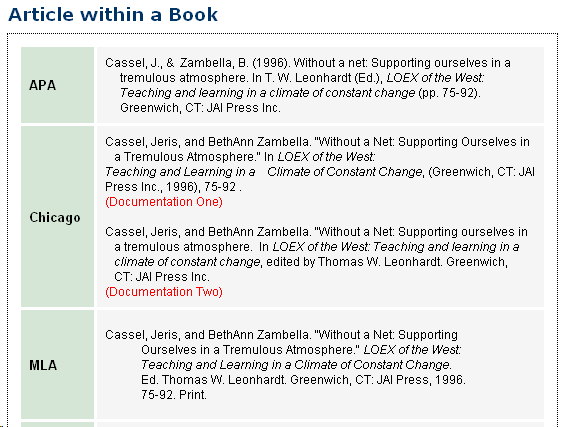
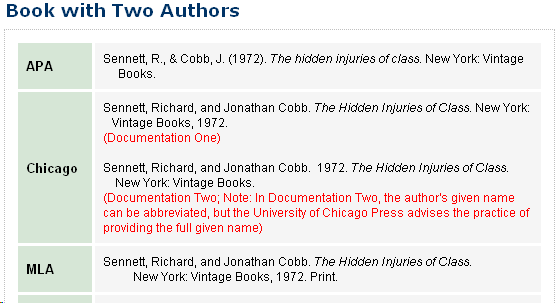
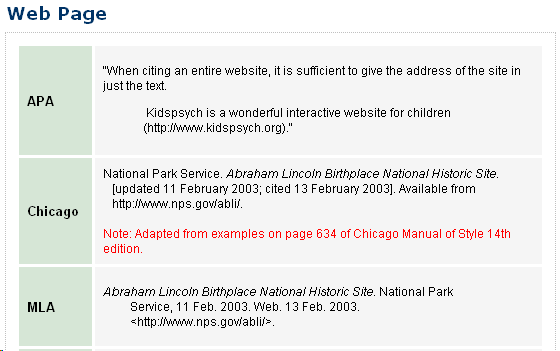
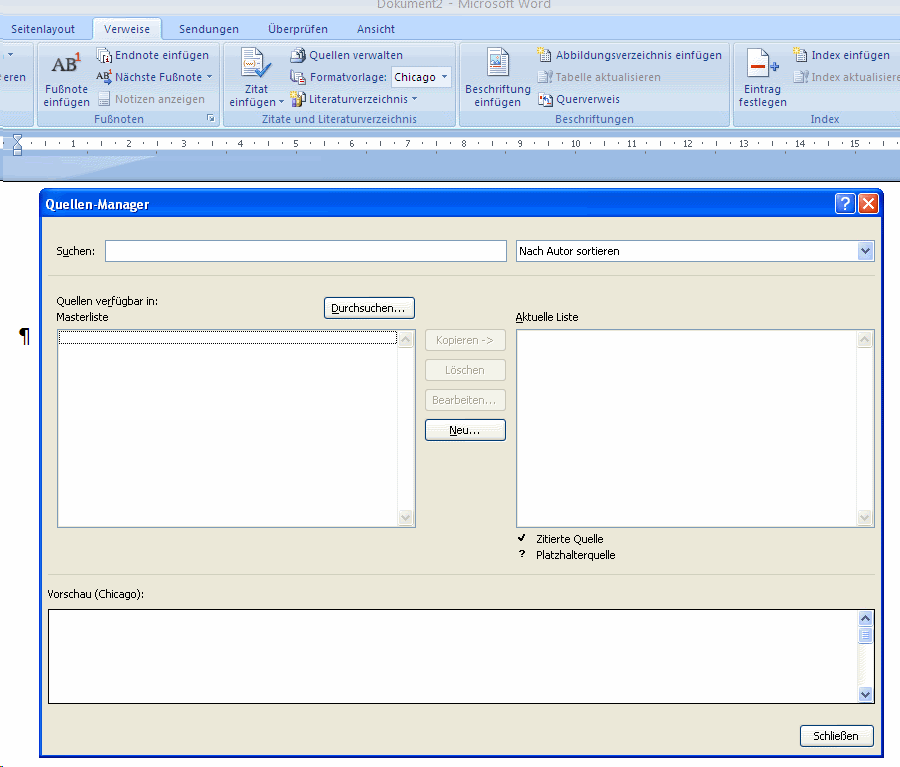
Word 2007 supports several citation systems:
QUESTIONS?
Plenum
Q&A Assignment
Discussion
about assignment with small group: Countries
|