|
Welcome to the Experience
Economy,
the next step of global economic development
after the
service/knowledge economy.
EVERY BUSINESS IS A STAGE
http://www.kristallwelten.com/
http://www.heinekenexperience.com/
http://www.edenproject.com/
Economic Distinctions - Table (offline)
Commodities --> Goods --> Services -->
Experiences
EXPERIENCE REALMS - ALL
EXPERIENCES ARE REAL
"Ing the Thing" - Experientalizing your
offers
Selling the "-ing experience":
Embedding Goods in an Experiential Brand
Sensorializing Goods
Making Goods Scarce
Forming a Goods Club
Staging a Goods Event
"The Progression of Economic
Value"
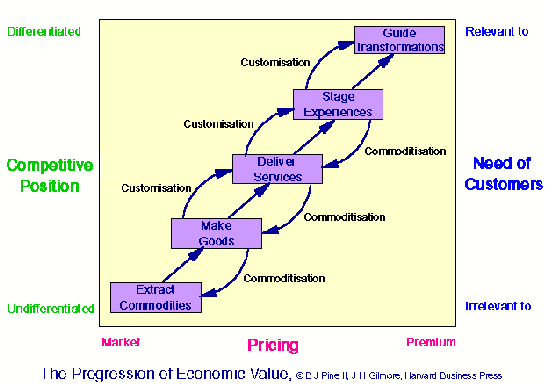
Example: The
Birthday Cake
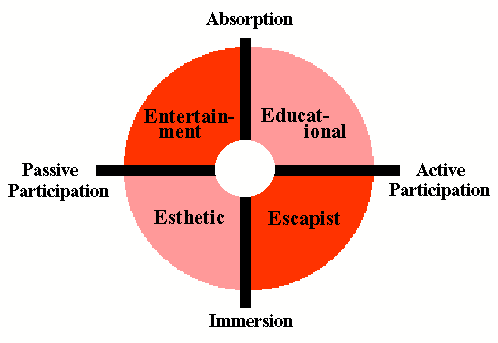
"The Experience Realms"
|
Passive Absorption:
f.i. TV, Listening to Music
To Sense |
Active Absorption:
f.i. Hands-on exhibit in a
museum
To Learn |
|
Passive Immersion:
f.i. Concert
To Be |
Active Immersion:
f.i. Skiing
To
Do |
"There's no such thing
as an artificial experience" -
but is there a
hierarchy of experiences?
Theming the
experience An example:
* The American Girl
Place in Chicago charges school-age girls and their parents admission to see a
musical review and dine in a themed café based on the American Girl dolls and
books. They can spend hundreds of dollars in the American Girl Place for
experiences and they haven’t yet bought a thing.
http://www.americangirlplace.com/agp_home.php
Another example:
Experiencing
God
Should the church
see itself in the business of providing spiritual experiences for seekers or is
the concept foreign to the gospel? There are sharp disagreements among Christian
leaders over these issues.
American church
leaders: “The church in the experience economy must move beyond simply providing
services to a new sense of -- you should pardon the theologically impaired term
-- enchantment.” “It will be expected
and needed to engage people in this new culture.”
“We are really
interested in the concept, not only because that’s where the culture is going
but because … that’s what the church is in the business of -- transformational
experiences."
North Coast Church
in California has been designing its worship services from an experiential point
of view for several years -- before they even heard of the concept.
When the
congregation outgrew its 600-seat sanctuary, church leaders thought about
opening overflow rooms but knew they needed to do more. So they created a
different worship experience -- a video café with live worship music in a casual
setting but with the same sermon shown on a video projector.
Rather than
“punishing” latecomers by sending them to an overflow room, the video café is an
attractive alternative that reaches a different type of worshipers. It has been
so popular that occasionally the café fills first, and the main sanctuary
becomes the “overflow.”
Two more alternative
experiences have since been added -- a traditional service and a Gen-X service
-- creating four distinct, simultaneous, themed worship experiences, each with
live worship music but sharing the same preacher and sermon.
North Coast Church
has about 4,000 or more people in worship on a typical weekend, with most of
them attending the video cafés. “It’s a megachurch that doesn’t feel like one,”
says Osborne. “Each preserves a small-church feel.”
In truth, religious
american author Sweet says, Christians “are the experience
experts.”
Theming the
"authentic" Christian experience
Lake Pointe Church
near Dallas is using theming in its children’s facilities to enhance the
experience. Built near a lake, the church’s children’s building has aquariums
and an indoor dock, where “fish” are caught with magnetic fishing poles.
Children can play on a gym set like the ones they find at McDonalds. All
grade-school departments have video projection equipment and computers equipped
with Powerpoint presentation software. A slide carries elementary children down
from classrooms on the second floor. “The experience
economy is selling people a fake experience. What we have to offer is a real
experience.” That’s particularly important with youth and young adults, who are
very sensitive to faux faith, he said. “Youth want authenticity.” So Lake Pointe
won’t use any plastic rocks or fake waterfalls in the youth facility they are
building. “They are wanting experience, but they want a real
experience.”
|
Now, what do you think of
that? |
"You are what you charge for"
When you start charging an entrance
fee for your attraction/shop/sight,
visitors can rightly demand
something for it
(all the time, always on the same level).
Consequences for:
- a souvenir shop?
- a restaurant?
- a beach (Kurtaxe...)?
- a city destination?
|